
By Steven Durost
One of the most important lessons I have learned in Therapeutic Spiral Model (TSM) psychodrama is that profound healing does not begin when a person starts talking about trauma. It begins when the environment becomes safe enough for the nervous system, the individual, and the group to trust what is about to unfold.
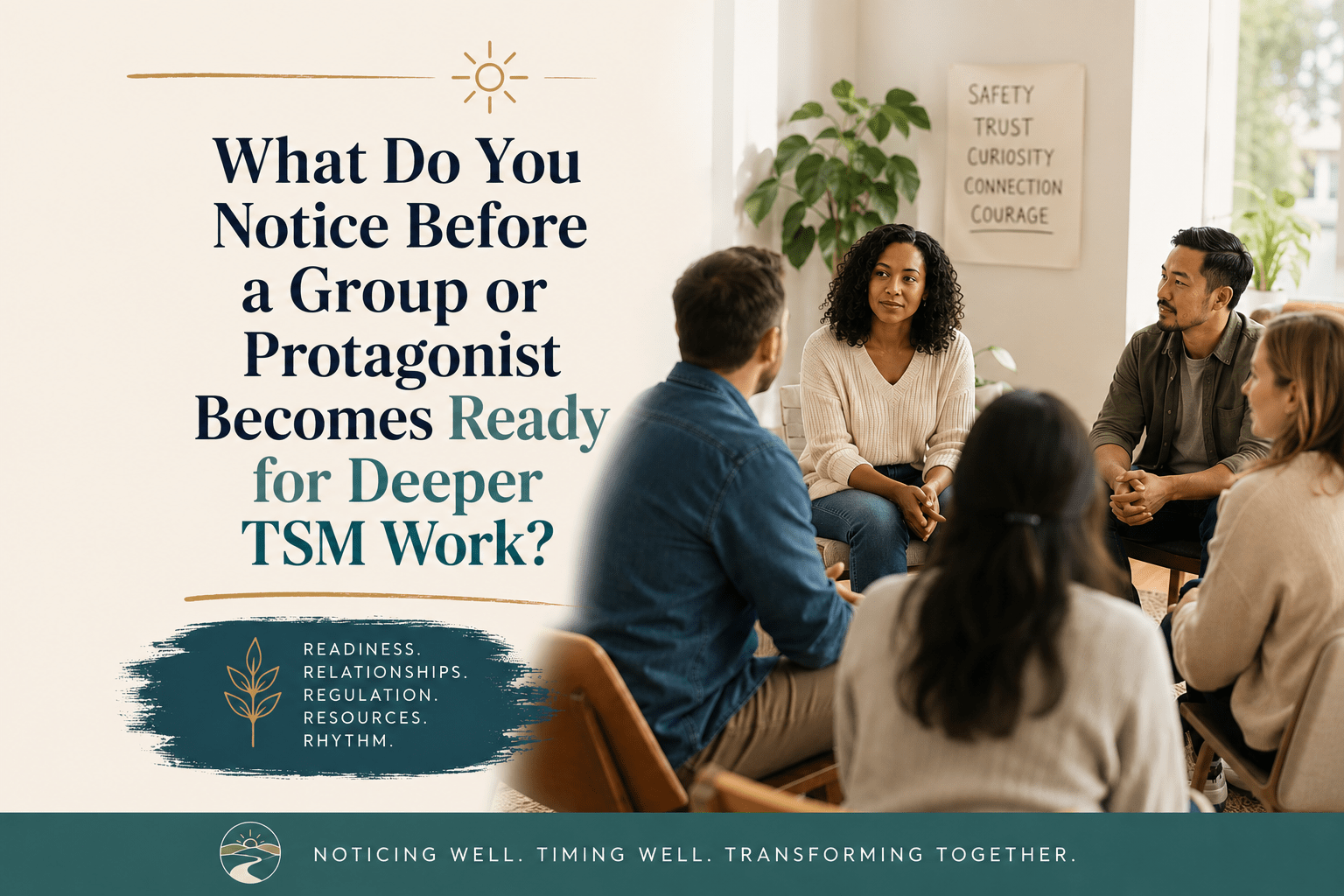
Before a group or protagonist is ready for deeper work, something subtle yet unmistakable begins to emerge. Anxiety decreases. Authenticity increases. Group members stop monitoring how they are being perceived and start responding spontaneously from their true selves. The atmosphere becomes more connected, more emotionally accurate, and more alive.
I have come to think of this state as immersive tele and interpersonal spontaneity.
Immersive Tele: Swimming in Accurate Connection
Tele, as described by Jacob L. Moreno, refers to the accurate, two-way emotional connections that exist between people. When tele becomes strong enough and fear becomes low enough, participants begin to feel held within a field of genuine human connection.
In these moments, group members are no longer merely sitting beside one another—they are immersed in a network of meaningful relationships. They trust that they can act, speak, and feel without being judged or shamed. I presented this (and the next) phenomenon for the first time in the most recent book on TSM Psychodrama with Dr. Kate.
Interpersonal Spontaneity: Authentic Action in Relationship
As tele deepens, a second state emerges: interpersonal spontaneity.
This is the point at which participants begin to respond naturally and courageously to one another. They role-play authentically, receive projections without defensiveness, and offer truthful responses from their own lived experience. Rather than “performing” in the group, they become fully present.
The group starts functioning as a self-healing organism.
Signs That a Group Is Ready for Deeper TSM Work
Before moving into deeper trauma processing, I look for several indicators:
- Members are emotionally engaged and responsive.
- Participants speak with increasing honesty and vulnerability.
- Judgment and self-consciousness diminish.
- Role-playing becomes natural rather than forced.
- Group members support one another spontaneously.
- The protagonist feels held rather than exposed.
- Corrective emotional experiences begin to arise organically.
When these signs are present, the group has reached a critical threshold. Safety is no longer simply a concept; it has become an embodied experience.
The Group as a Self-Healing Brain
At its best, the group begins to function like a living brain. Individual members become interconnected neurons transmitting empathy, truth, and healing. What emerges is often far more intelligent and compassionate than what any single member or director could consciously orchestrate.
This is the moment when psychodrama stops being something we “do” and becomes something that unfolds naturally.
Trust the Field
One of the greatest mistakes a director can make is moving too quickly toward traumatic material before immersive tele and interpersonal spontaneity are established. Conversely, when these conditions are present, healing tends to arise organically and with remarkable precision.
Before deeper work begins, I notice a shift in the room. The group feels more cohesive, more courageous, and more genuine. There is a palpable sense that something larger than any individual is present and ready to support transformation.
That is when I know the group is ready.
And when that happens, the work really opens up to amazing possibilities.