
TSI Certification Process

What is TSM?
The Therapeutic Spiral Model is a clinically modified form of psychodrama specifically developed for the safe and effective treatment of psychological trauma. It was introduced in 1992 and has since been widely applied and researched internationally.
At its core, TSM is based on the premise that trauma survivors must first be adequately resourced before engaging with traumatic material. This resourcing involves the development and internalization of specific protective, containing, and reflective roles (often referred to as prescriptive roles). Only when these roles are sufficiently established can traumatic experiences be explored without re-traumatization.
Key characteristics of TSM include:
- A phase-oriented, containment-focused approach to trauma treatment
- The use of experiential and action methods grounded in psychodrama
- Emphasis on safety, stabilization, and conscious choice
- A focus on post-traumatic growth, not only symptom reduction
TSM is used with individuals, groups, and communities and is particularly suited for people presenting with:
- PTSD and complex trauma
- Anxiety and depressive symptoms
- Trauma related to physical or emotional abuse, childhood sexual abuse, sexual violence, torture, war, ethnic conflict, and structural violence
Beyond trauma treatment, TSM has also been applied in work with addictions, eating disorders, and in broader contexts such as education, theatre, community development, business, and legal settings.
Training and certification in TSM are provided by Therapeutic Spiral International (TSI), which offers a structured training pathway for mental health professionals and related practitioners working with high levels of stress and trauma.

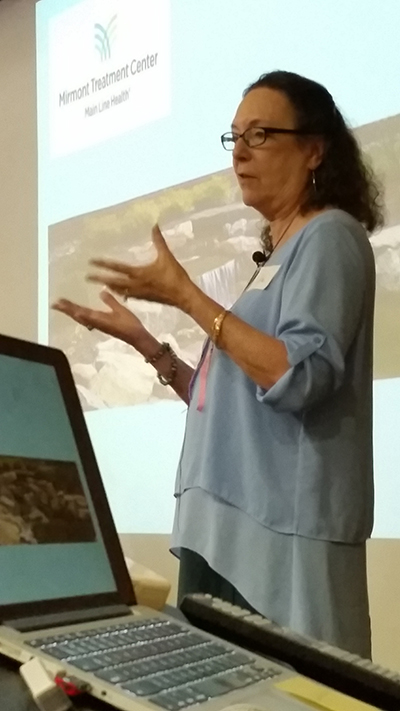
Dr Kate teaching at Mirmont Treatment Center, Lima, PA
TSI Certification Programs
TSI International offers certifications in Experiential Trauma Therapy, combining theory, practice, and supervision. Courses can be taken individually and provide immediately applicable TSM interventions. Training is highly experiential and offered as weekend workshops or week-long intensives, typically lasting at least three days, teaching participants to address trauma safely through action methods.
Skills develop quickly through demonstrations, supervised practice, and full TSM psychodramas. Personal growth is emphasized, with opportunities to work on one’s own issues while supporting others’ healing. Many professionals begin with a personal growth workshop to experience TSM firsthand, fulfilling the personal experience requirement.
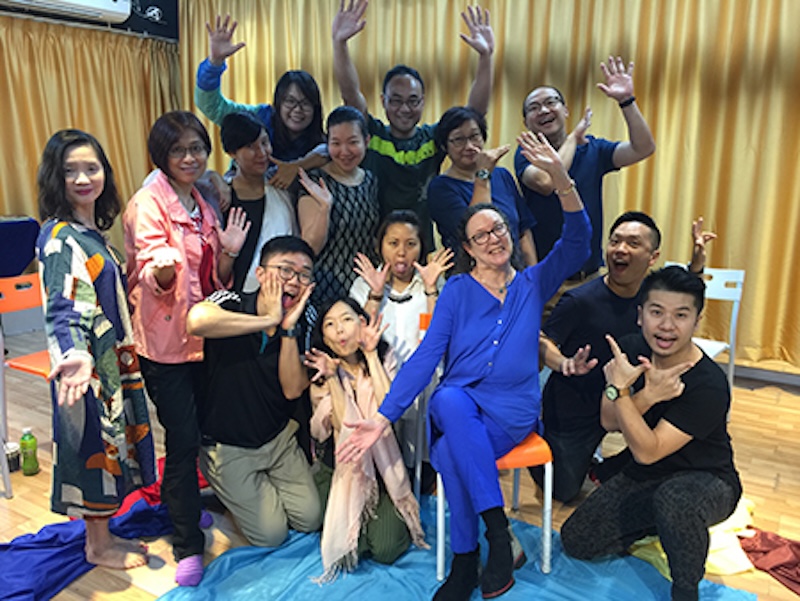
Criteria for Entry into the Certification Process in TSM Psychodrama
To be eligible for entry into the Therapeutic Spiral Model (TSM) Psychodrama Certification Process, applicants must meet the following requirements:
- Educational Background: Applicants must hold a Master’s degree and be working toward certification in psychodrama or another experiential or expressive arts therapy.
Applicants who do not meet these formal requirements but who possess comparable international qualifications, equivalent clinical experience, or substantial experiential training may request a waiver of the entry requirements. Such requests should be submitted to the Clinical Director and Director of Training for consideration. - Participation in TSI Workshops: Applicants must have participated in at least one Therapeutic Spiral International (TSI) Training Workshop and/or one TSI Personal Growth Workshop, taking appropriate auxiliary roles as a group member.
- Professional Recommendation: A formal recommendation is required from the Team Leader or Trainer of the TSI workshop(s) in which the applicant has participated, confirming readiness to enter the formal TSI training process.
- Application Documentation: Applicants must submit the following to the Clinical Director and Director of Training:
- A current curriculum vitae (CV)
- A letter or email requesting entry into the TSM Certification Process, including a brief statement outlining the applicant’s motivation for applying and what they hope to gain from the program
- Application Fee: A non-refundable application fee of US $100 is required.
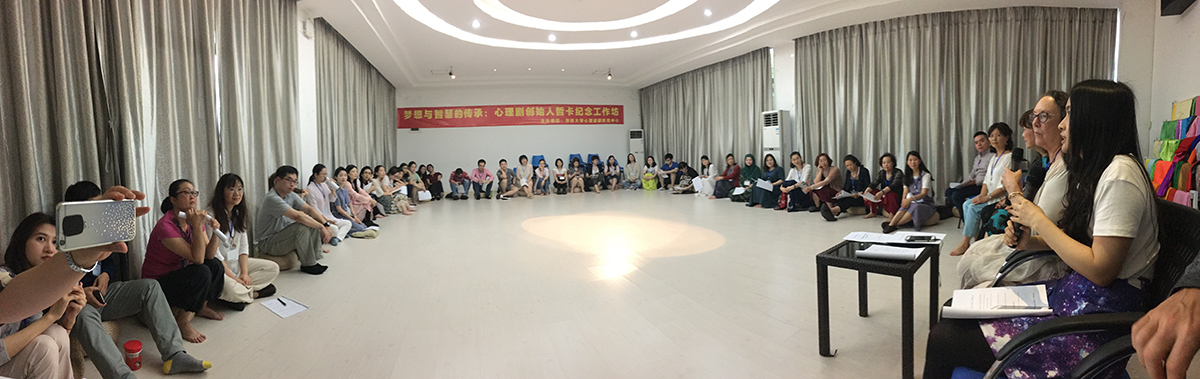
Workshop with Drs Lai Nienhwa and Dr Kate celebrating Zerka’s 100th birthday in Xiamen China
Level II: Advanced Theory and Practice
The Level II: Advanced Theory and Practice certification is awarded to individuals who have met the following criteria:
- all requirements for Level I Certification;
- three Level II Advanced Clinical Courses;
- demonstrated competency at the desired certification level:
Trained Auxiliary Ego (TAE), Assistant Leader (AL), or Team Leader (TL); - Appropriate supervision.
TSI Certificate
TSI Certificate
The International Trainer Certification in the Theory and Practice of Experiential Trauma Therapy using the Therapeutic Spiral Model is awarded to individuals who have successfully fulfilled all of the following requirements:
- completion of all requirements for both the Level I and Level II Certifications, as outlined above;
- co-teaching each of the courses for which certification is granted;
- independently teaching each of the courses for which certification is granted, with either on-site or video-based supervision;
- serving as a Presenter or Co-Presenter of a Therapeutic Spiral Model–themed workshop at a national or international conference; and
- participation in appropriate professional supervision.
Note: Workshops led by TSI Trainers who are also TEPs, PATs, and/or RDTs may count toward certification with the American Board of Examiners in Psychodrama, Sociometry, and Group Psychotherapy, the American Society for Experiential Therapists, and the North American Drama Therapy Association. Hours may also be recognized by accrediting boards in other countries. Continuing education credits may be available for psychologists, social workers, marriage and family therapists, addiction counsellors, licensed professional counsellors, and certified group psychotherapists.
To become a certified TSM trainer you must:
- Attend 4 Core Training Workshops (3 days each):
- Workshop1: Neurobiology of Trauma – 3 days
- Workshop 2: Containment – 3 days
- Workshop 3: Becoming Friends with Defenses – 3 days
- Workshop 4: Transforming the Trauma Triangle – 3 days
Total: 12 days
Note: The workshops do not need to be taken in a specific order.
- Attend at least one TSM Personal Growth Workshop to deepen experiential learning and self-awareness.
- Complete all assigned literature to build theoretical understanding and clinical knowledge of TSM.
- Participate in appropriate supervision during or after the workshops to integrate TSM into your professional practice.
- Write after each workshop a reaction Paper: approximately 5,000 words in English, reflecting on how TSM theory has influenced or will influence your professional work.
Once you have completed any one of the four core workshops, you can:
-
- Begin training as a TSM Trained Auxiliary if the workshop is offered in that format.
- Start your pathway to becoming a TSM Trainer.
Note: Full certification still requires completion of all four core workshops.
Summary:
- 4 core workshops (3 days each, any order)
- 1 personal growth workshop
- required reading
- supervision +
- reaction paper or training journal.
- After attending any single workshop, you may begin auxiliary or trainer training while completing the remaining workshop
Maintaining Certification
Certified practitioners (TAE, AL, TL) are expected to support or lead a TSM workshop at least once a year. Trainers must offer at least one TSI-sponsored workshop annually or present at a national or international TSM conference.
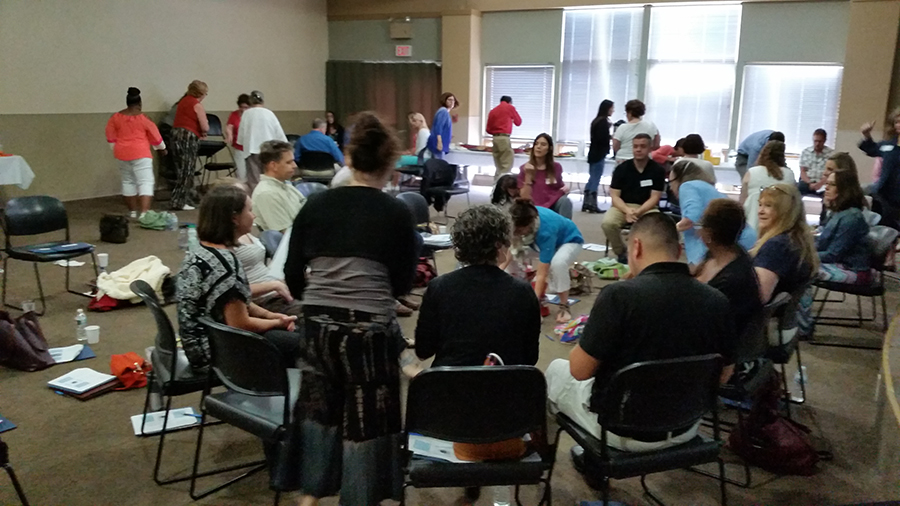
Dr Kate was invited by Scott Giacomucci to bring TSM to the Mirmont Treatment Center in Media PA.
Workshop 1 – The Brain in Action: Neurobiology of Trauma
Trauma reshapes the brain and nervous system in profound ways. The right hemisphere, where emotions, relationships, and unprocessed trauma live, becomes overactive under the influence of a hyper-alert amygdala. At the same time, the left hemisphere, which helps us stay present and make sense of experience, is disrupted by stress hormones. Interpersonal interactions also shape brain development, influencing deeper structures like the vagus nerve.
In this workshop, you will explore the neurobiology of PTSD in action. Through real-life and simulated scenarios, you will bring your own experiences—and your clients’ stories—into the learning process. Using Brain in Action, a unique TSM method, complex neurobiological processes are transformed into a clear, visual framework that makes the science practical, interactive, and immediately applicable.
You will also practice TSM interventions that address trauma-related survival defenses. The Body Double (BD), developed by Linda Ciotola, M.Ed, TEP, helps you and your clients tune into bodily sensations, thoughts, and feelings—supporting self-regulation, self-soothing, and narrative labelling, even during flashbacks or body memories.
By the end of the workshop, you will be able to;
- Explain recent research on the brain, attachment, and trauma.
- Understand why experiential treatment is key for trauma and related disorders, including addictions and eating disorders.
- Demonstrate healthy and traumatized brain processes using Brain in Action.
- Apply the TSM Body Double intervention in practice.
- Plan how to integrate workshop learning into their professional work.
Workshop 2 – Containment: Unlocking Safety with Action Methods
In this workshop, you will actively work with the Trauma Survivor’s Internal Role Atom (TSIRA) to contain and process residual trauma. You’ll practice balancing thinking and feeling, holding unprocessed memories safely, and creating adaptive responses to old trauma patterns.
A core skill, the Containing Double (CD), empowers you and your clients to stay present while expressing intense emotions and taking spontaneous, creative action. Through demonstrations and guided practice, you’ll learn to adjust the container to match the intensity of thoughts, defenses, or feelings—transforming old patterns into present-moment awareness.
Key Takeaways:
- Understand why containment is essential for experiential methods.
- Learn the three TSM protocol stages: Prescriptive, Trauma-based, and Transformative Roles.
- Practice the Containing Double to balance cognition and emotion.
- Create safe spaces for expressing grief, rage, despair, and fear.
- Accurately label thoughts and feelings to guide transformative action.
- Apply these skills directly to professional practice.
Workshop 3 – Making Friends with Defenses in Action
This workshop explores the defenses people develop during trauma to survive and protect themselves—patterns that can persist into adulthood as habits, compulsions, or coping strategies. While these defenses were once adaptive, they can become limiting when they no longer support growth, creativity, or spontaneity.
You learn the TSM Manager of Defenses (MD) intervention, a hands-on approach to bring unconscious defenses into awareness, understand their purpose, and transform them into healthy psychological protections. Through enactment and practical exercises, you will learn to ‘re-write’ your defenses so they support you in the present, rather than holding you back from the past.
By the end of this workshop, you will know how to:
- Recognize and describe common defenses following trauma, from survival strategies to maladaptive coping skills.
- Apply the TSM Manager of Defenses intervention in clinical and professional settings.
- Identify their own frequently used defenses and explore ways to transform them into higher-order coping skills.
- Plan concrete ways to integrate these insights into their professional practice.
Workshop 4 – Transforming the Trauma Triangle to Post-Traumatic Growth
In this workshop, you will explore the trauma-based roles of the TSIRA through TSM’s Trauma Triangle—a framework that exposes the destructive cycle of Victim, Perpetrator, and Abandoning Authority. While Karpman’s Triangle is widely used in addiction treatment to describe interpersonal roles of Victim, Perpetrator, and Rescuer, TSM focuses on the internalized experience of trauma survivors.
Through role theory, you will see how the Trauma Triangle captures the internal roles of Victim, Perpetrator, and Abandoning Authority—the last arising when no rescuer exists in your world. The Abandoning Authority shows how survivors may abandon themselves to dissociation, self-harm, addictions, eating disorders, or neglecting self-care.
This role builds on Dusty Miller’s work on Trauma Re-enactment Syndrome and the Non-Protecting Bystander (Miller, D. [1994]. Women Who Hurt Themselves: A Book of Hope and Understanding. Harper Collins, New York, NY).
The Trauma Triangle reflects patterns embedded in your personality that repeat cycles of abuse and neglect. In this workshop, you will actively work with personal dramas to transform trauma-based roles, shift from self-neglect to self-care, and embed healthy problem-solving in your daily life. You will also learn to develop the transformative role of Appropriate Authority as a way to break free from the TSM Trauma Triangle.
You will practice assessment and enactment of the Trauma Triangle through multiple methods: using pen and paper, walking the triangle physically, or through sociodrama and individual psychodramas.
By the end of this workshop, you will be able to:
- Describe the TSM Trauma Triangle and apply it in education, therapy, and organizational contexts.
- Explain assessment methods in working with the TSM trauma-based roles of victim, perpetrator, and abandoning authority.
- Demonstrate ways to integrate TSM’s prescriptive roles to enact and transform the trauma-based roles safely and without re-traumatization.
- Explain their personal pattern on the Trauma Triangle.
- Transform the identified pattern and build the role of Appropriate Authority that can stop the repetitious internalized pattern of trauma.